American Society of Hirudotherapy

Medicinal Leech Anatomy

External and internal anatomy — 33–34 segments, tripartite jaw, and crop-based blood storage

Last Updated: May 26, 2026ASH Editorial · based on the books
Descriptive biology: Content describes science, methodology, or organizational reference material — not a clinical efficacy claim.Educational reference: Content is historical, educational, or biographical reference material — not a clinical recommendation.

Biology context: See the Coverage Map for the broader picture of what is and isn't studied across clinical specialties, and the Research Roadmap for ASH's evidence-gap priorities.

The medicinal leech (Hirudo medicinalis) is a highly specialized hematophagous annelid with anatomical adaptations for blood feeding and storage. Understanding these structures is essential for clinical use and infection control.

External Anatomy

  • 33–34 segments — 33 according to Baskova and Isakhanyan, 34 according to Michalsen et al.; the skin is divided into about a hundred rings (annuli) — 103 and 105 respectively — with up to five rings per segment in the middle of the body
  • Anterior sucker — oral sucker containing three muscular jaws arranged at 120° angles
  • Posterior sucker — caudal sucker used for attachment and locomotion (no jaws)
  • 5 pairs of eyes — arranged in an arc on the dorsal surface of the anterior sucker; photosensitive organs used for detecting shadows (predator avoidance)
  • Excretory pores — 17 pairs of small openings of the excretory organs (nephridia) on the underside of the body
  • Gonopores — male and female reproductive openings on the underside, five rings apart (the leech is a hermaphrodite)

The segmented body plan allows remarkable flexibility — leeches can contract to 1/3 of extended length or stretch to 3x resting length.
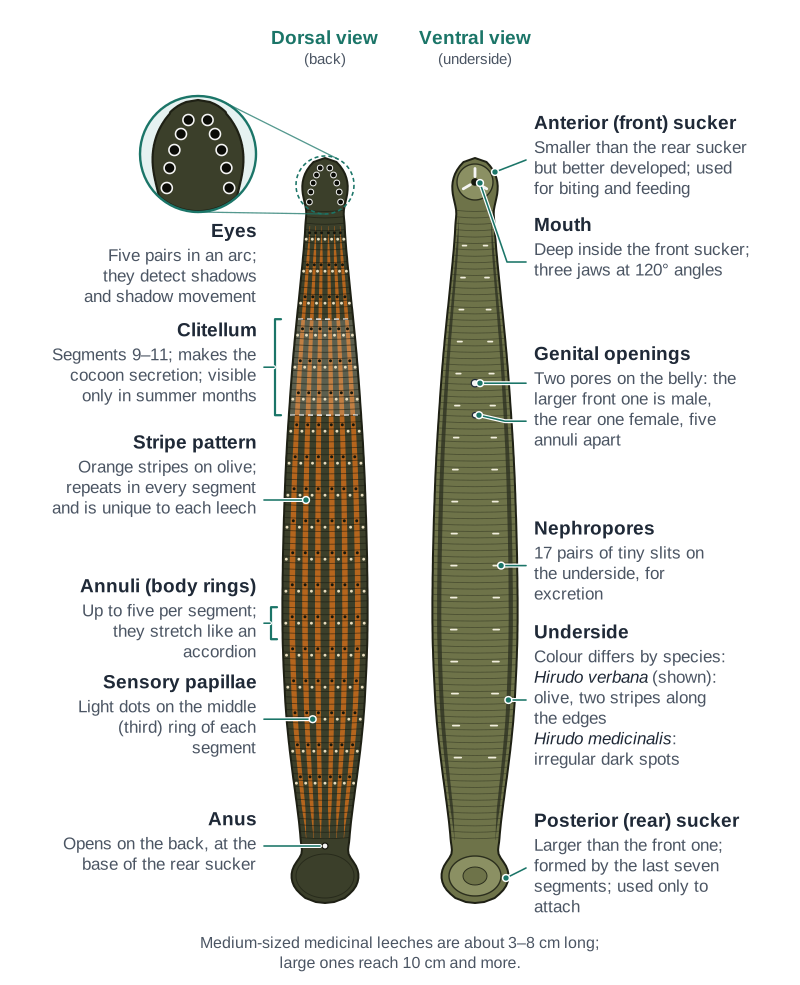
Two drawings of a medicinal leech side by side, head at the top: the back (dorsal view) on the left and the underside (ventral view) on the right. The back is dark olive with orange stripes and about a hundred fine body rings (annuli, up to five per segment), with light dots (sensory papillae) on the middle ring of each segment, a dashed band marking the clitellum in segments 9–11, five pairs of eyes in an arc on the head (shown enlarged in a circle) and the anus at the base of the rear sucker. The lighter olive underside shows the small front sucker with the mouth and its three jaws inside, two genital pores (the larger front one male, the rear one female, five rings apart), 17 pairs of tiny excretory slits and the larger rear sucker formed by the last seven segments. Labels note that the underside colouring differs by species (Hirudo verbana, shown: olive with two stripes along the edges; Hirudo medicinalis: irregular dark spots) and that medium-sized medicinal leeches are about 3–8 cm long and large ones 10 cm or more.
External anatomy of the medicinal leech seen from the back and from the underside: suckers, mouth, eyes, body rings, stripe pattern and body openings. Open full size Source: ASH diagram based on Michalsen, Roth & Dobos 2007 and Baskova & Isakhanyan 2004

Internal Anatomy

  • Crop (gastric cecum) — stores 5-10x body weight in blood; largest internal organ. Blood remains liquid for months through anticoagulant enzymes.
  • 10 pairs of intestinal diverticula — extend from crop, increase storage capacity
  • Coelomic sinuses — no true circulatory system; fluid-filled cavities transport nutrients and oxygen
  • 17 pairs of nephridia — excretory organs analogous to kidneys
  • Hermaphroditic reproductive system — both ovaries and testes present; reproduction via cocoon deposition
  • Ventral nerve cord — 21 segmental ganglia connected by paired nerve cords
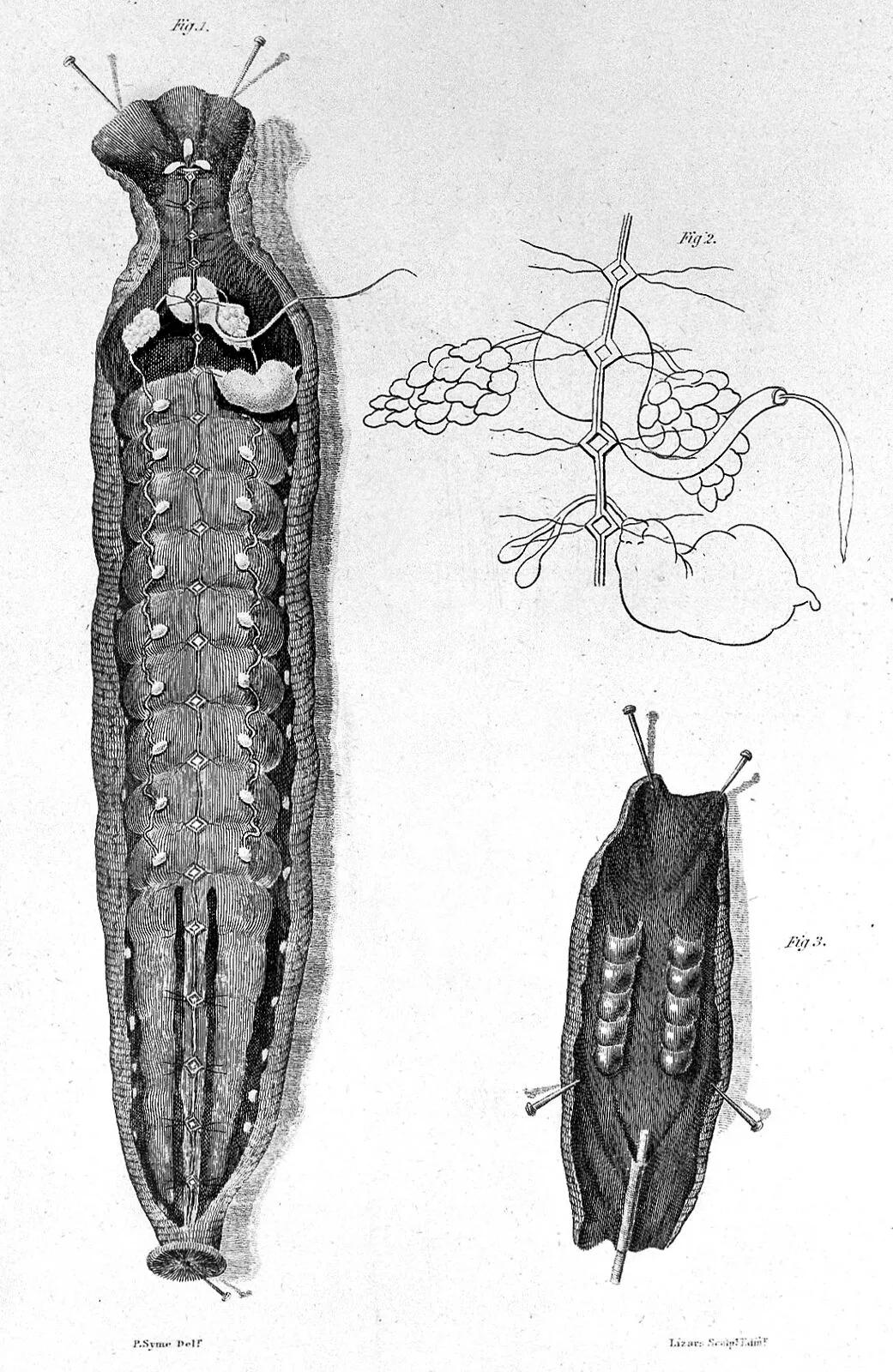
Black-and-white engraved plate of leech dissections: a whole leech opened lengthwise and pinned out (fig. 1), a nerve cord with lobed organs attached (fig. 2) and a short opened segment (fig. 3).
A plate of dissections of the medicinal leech from James Rawlins Johnson, A Treatise on the Medicinal Leech (London, 1816). Source: Wellcome Collection · Public Domain Mark

The Jaw Apparatus

The tripartite jaw system is the defining anatomical feature of Hirudo and other jawed leeches (Arhynchobdellida):

  • 3 muscular jaws arranged at 120° angles (dorsal + 2 ventrolateral)
  • ~80 chitinous teeth per jaw (total ~240 teeth)
  • Y-shaped incision — creates characteristic triradiate wound (often called "Mercedes-Benz" pattern)
  • Salivary ducts — open between teeth, delivering anticoagulant cocktail directly into wound

The jaw musculature can generate significant force — up to 10 Newton (~1 kg force) — allowing penetration through epidermis into capillary beds.
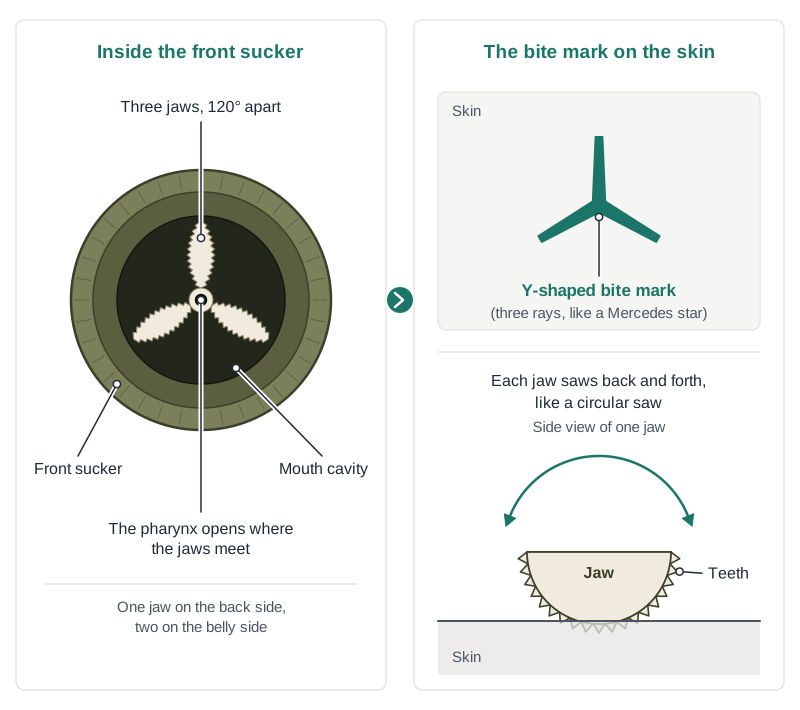
Two panels side by side. On the left, the front sucker of a medicinal leech seen from the front: inside the dark mouth cavity three pale, finely toothed jaws meet in the centre at 120° to one another, like a three-pointed star, one on the back side and two on the belly side; the pharynx opens at the point where the jaws meet. On the right, the Y-shaped, three-rayed bite mark that the jaws leave on the skin, and below it a side view of one semicircular, toothed jaw that rocks back and forth like a circular saw as it cuts into the skin.
The three toothed jaws inside the front sucker, 120° apart, saw into the skin like small circular saws and leave a Y-shaped, three-rayed bite mark. Open full size Source: ASH diagram based on Michalsen, Roth & Dobos 2007 and Baskova & Isakhanyan 2004

Wound Geometry Optimization

The triradiate jaw creates a wound geometry optimized for both active blood extraction (capillary rupture) and prolonged passive bleeding (large surface area for anticoagulant diffusion).

Anatomical Summary Table

Organ/StructureLocationFunctionClinical Relevance
CropMid-body (segments 10-18)Blood storage (5-10x body wt)Sustains leech for months between feedings
Tripartite jawsAnterior suckerY-shaped incisionCreates optimal wound for blood flow + anticoagulant delivery
Salivary glandsPaired, along jawsSecrete salivary proteins (189 identified in H. medicinalis)Anticoagulation, vasodilation, anti-inflammatory effects
Ventral nerve cordVentral midlineCentral nervous system (21 ganglia)Sensory processing, host detection
Nephridia (17 pairs)Segmentally distributedExcretion of metabolic wasteMaintains homeostasis during prolonged digestion
Eyes (5 pairs)Dorsal anteriorPhotoreception (shadow detection)Predator avoidance; negative phototaxis aids attachment

Educational Disclaimer

This page describes biological properties of medicinal leeches for educational purposes. Discussion of biological mechanisms does not constitute evidence of therapeutic efficacy.

Related Resources

This website provides educational information and does not constitute medical advice, diagnosis, or treatment recommendations. Medicinal leech therapy carries clinically meaningful risks and should be performed only by qualified clinicians under institutionally approved protocols. FDA 510(k) clearance for medicinal leeches is limited to specific indications; investigational and off-label discussions are labeled accordingly. For patient-specific guidance, consult a qualified healthcare provider.