Your Guide to Leech Therapy
What to expect before, during, and after hirudotherapy — written for patients, by medical professionals
What this guide does NOT say
- FDA clearance covers ONE specific use — relieving venous congestion in microsurgical flap salvage. All other uses are off-label or investigational.
- Not a substitute for clinician judgment. Always consult a licensed medical provider before considering this therapy.
- Not for home use. Medicinal leech therapy must be performed under medical supervision with proper sourcing, sterile protocols, and infection-control measures.
- Not a cure-all. The 174 conditions where leech therapy has been studied have widely varying evidence levels — see Conditions Atlas for tier-classified detail.
Safety resources before considering hirudotherapy
What conditions has hirudotherapy been studied for?
174 medical conditions are catalogued in the ASH Conditions Atlas. Each entry shows the evidence tier, FDA status, contraindications, and questions to ask your clinician. Tier A = FDA-cleared. Tier B = supported by randomized trials but off-label. Tier C = limited human evidence (investigational).
Before considering hirudotherapy for any condition, read its specific page in the atlas. Each includes patient-summary information, risks, and red flags for urgent care.
If you’re reading this, you’re probably curious — or maybe a little nervous — about leech therapy. That’s completely normal. A systematic review of 277 reported cases of leech therapy in plastic and reconstructive surgery has been published (Whitaker et al., Microsurgery, 2012).
This guide walks you through every step so you can feel confident and prepared.
FDA-Cleared Indication
FDA-Cleared. Medicinal leeches are classified as FDA 510(k)-cleared medical devices by the U.S. Food and Drug Administration. They are used at major U.S. academic medical centers; published case reports come, for example, from Massachusetts General Hospital (Caragher et al., Plast Reconstr Surg Glob Open, 2022) and from a team including Johns Hopkins surgeons (Mamelak et al., J Drugs Dermatol, 2010).
Printable patient handout
A one-page printable summary of safety, contraindications, and what to expect — bring it to your appointment or save as PDF.
Is Leech Therapy Right for You?
Leech therapy works best for certain conditions. Here’s a quick overview.
Important: Not for Self-Application
Medicinal leech therapy is a regulated clinical procedure. Do not purchase, apply, or attempt leech therapy at home or without a trained clinician. Untrained use can cause uncontrolled bleeding, severe infection (Aeromonas hydrophila), allergic reactions, scarring, and treatment failure. Only physicians, nurse practitioners, and licensed clinicians using FDA-cleared medicinal leeches in a controlled clinical setting can safely deliver this treatment.
Who Should Not Receive Leech Therapy
Before treatment, tell your doctor about all your medical conditions and every medicine you take — and do not stop any prescribed medicine on your own. The lists follow the hirudotherapy books.
Absolute contraindications[B1][B3]
- Hemophilia or another bleeding disorder
- Taking anticoagulants (blood thinners such as warfarin or heparin)
- Anemia or suppressed blood formation
- Low blood pressure, shock, collapse or fainting
- Severe wasting (cachexia)
- Intolerance of leeches or a history of severe allergic reactions
- Pregnancy
- Stomach or duodenal ulcer, erosive gastritis
- Acute infectious disease or high fever
- Severe unstable illness, markedly weakened immunity (for example during chemotherapy) or HIV infection
- Drinking alcohol at the time of treatment
- No consent from the patient
Relative contraindications (require careful clinical evaluation)[B1][B3]
- Aspirin or clopidogrel: not a contraindication by themselves, but the doctor starts with fewer leeches
- Poor wound healing (for example in diabetes) or a tendency to keloid scars
- Severe long-term but stable illness: cirrhosis of the liver, dialysis, connective-tissue or immune disease, blood disorders
- Children: only as prescribed by a doctor, with fewer leeches
- Surgery patients who cannot take the antibiotics given alongside leech therapy
- Visible areas where a bite mark could be a cosmetic concern
Before treatment your doctor reviews your medical history, your medicines and your blood count. Also tell your doctor about any recent surgery or procedure. If leech therapy is not suitable for you, your doctor will discuss other options.
Important: Talk to Your Doctor First
Leech therapy may not be right for everyone. Your doctor should evaluate whether it’s appropriate for you, especially if you take blood thinners, have a bleeding disorder, or are immunocompromised. Always consult your physician before starting any new treatment.
✅ FDA-Cleared Indication
- •Venous congestion after reconstructive surgery (flaps, replanted digits)
This is the only FDA-evaluated use of medicinal leeches.
📊 Strong Clinical Evidence (Off-Label)
- •Osteoarthritis — especially knee osteoarthritis (multiple RCTs)
These uses are supported by clinical studies but are not FDA-evaluated. Discuss with your healthcare provider.
🔬 Conditions Under Active Research
- •Hypertension — blood pressure management
- •Dermatological conditions — psoriasis, eczema
- •Pain syndromes — chronic back pain, migraines
- •Wound healing — diabetic ulcers, slow-healing wounds
- •Chronic venous insufficiency and varicose veins
- •Post-thrombotic syndrome
Good Candidates for Leech Therapy
Talk to your doctor about leech therapy if you:
- • Have one of the conditions listed above
- • Are looking for a drug-free, non-surgical option
- • Want to try an evidence-based integrative approach
- • Have not responded well to conventional treatments alone
Finding a Qualified Practitioner
Choosing the right practitioner is the most important step. Here’s what to look for:
Practitioner Checklist
Questions to Ask at Your First Visit
- 1“What training do you have in hirudotherapy?”
- 2“Where do you source your leeches? Are they FDA-cleared?”
- 3“How many treatments have you performed?”
- 4“What results can I realistically expect?”
- 5“How do you handle complications if they arise?”
- 6“Will you coordinate with my primary care doctor?”
Before Your Session
How to Prepare
24 Hours Before
- • Stay well hydrated
- • Avoid alcohol
- • Skip lotions or perfumes on the treatment area
- • Eat a normal meal — don’t come on an empty stomach
Day Of
- • Shower normally (no scented products on treatment area)
- • Wear comfortable, loose clothing
- • Bring your medication list
- • Bring a book or headphones — sessions can last 1–2 hours
Tell Your Practitioner About
- • All medications — especially blood thinners, aspirin and blood-pressure medicines; leech therapy can lower blood pressure a little[B3]
- • Fainting during blood tests, injections or other procedures[B3]
- • Any tendency to bleed or bruise easily[B3]
- • Pregnancy, anemia, a stomach ulcer, diabetes or poor wound healing[B1][B3]
- • Any allergies
- • Previous leech therapy experience
- • Any recent infections or illness
During Your Treatment
Here’s what happens step by step. Most sessions take 1 to 2 hours total.
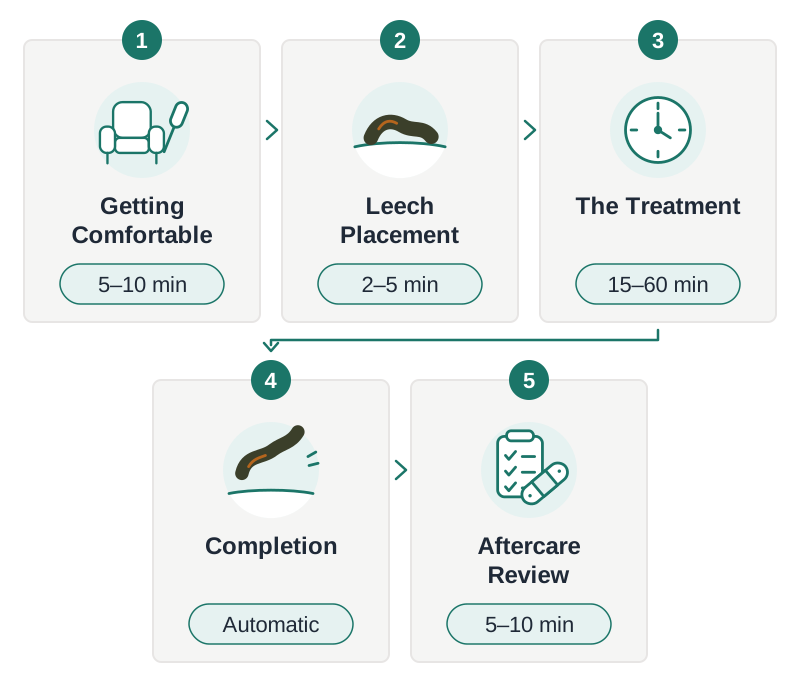
Getting Comfortable
5–10 minYour practitioner cleans the treatment area and makes sure you’re comfortable. They’ll answer any questions before starting.
The Treatment
15–60 minWhile the leech works, it delivers many bioactive components to the local tissue — anti-inflammatory agents, anticoagulants, and analgesic peptides. Once the first minutes have passed, the discomfort usually subsides[B3], although the pain may come back from time to time during the session[B2]. Read, listen to music, or just relax.
Completion
AutomaticWhen finished, the leech detaches on its own. Each leech is used only once — never shared between patients. Your practitioner then bandages the area.
Aftercare Review
5–10 minYou’ll receive simple aftercare instructions. How patients feel afterwards varies by indication. For the FDA-cleared microsurgical use the goal is preserving graft viability; for studied off-label uses such as knee OA, randomized trials report significant pain reduction within one to three weeks after a single session (day 7 in Michalsen 2003; day 21 in Stange 2012).
Does It Hurt?
After Your Treatment: What Is Normal and Possible Side Effects
What to Expect
First 24–48 Hours
- •Bleeding: The bite sites usually ooze blood from several hours to a day, sometimes longer[B1][B3]; this slow oozing is part of the treatment[B3]. Expect to change the dressing; the first change is usually the next day, preferably at the clinic[B3]. In hospital microsurgery, where many leeches are used for days, about half of patients need a blood transfusion; your provider will make sure the blood loss is safe for you.
- •Bandage care: Change as needed with sterile gauze
- •Take it easy: Rest on the day of treatment and avoid heavy exertion; keep the treated arm or leg raised as often as possible for at least two days, and do not drive on that day[B3]
Days 2–14
- •Mild itching: Very common — a positive sign of healing
- •Scarring: Leech bites leave small, triradiate (Y-shaped) marks about 1 mm across. The bite sites may stay visibly red for one to two weeks and usually heal without significant scarring, although minimal pale star-shaped scars sometimes remain
- •Results: Time-to-improvement varies by indication and individual response — see the sessions table below for typical timelines per condition.
When to get help right away
Contact your doctor or clinic if bleeding is heavy or does not stop and the dressing soaks through quickly; if redness around a bite keeps spreading and becoming more painful, especially with a fever, or red streaks run from the wound[B3]; if you feel unwell, dizzy or have fainted; or if you get hives all over the body, swelling of the face or difficulty breathing[B3]. Expected and not dangerous in itself: for 12–48 hours the wound edges swell a little and feel warm and red, small bruises may appear around the bite, nearby lymph nodes may swell for a while, and itching can last a few days[B1][B3]. Leech therapy does not replace emergency care: with signs of a stroke or heart attack, an acute glaucoma attack, severe abdominal pain, a high fever or any other life-threatening condition, call emergency services right away (in the US, 911).
How Many Sessions Will I Need?
Note: Every patient is different. The number of sessions and how often they are repeated depend on your condition and your response to treatment; your practitioner will agree a personalized plan with you before treatment starts.
Frequently Asked Questions
Is leech therapy safe?▾
Can leeches spread infections?▾
How much does a session cost?▾
What if I’m nervous about leeches?▾
Will I see the leeches?▾
Can I drive home after?▾
How is this different from taking medication?▾
Is leech therapy covered by insurance?▾
Can children receive leech therapy?▾
How long has leech therapy been used?▾
Additional Resources
Learn the Science
Explore how leech therapy works at a molecular level in our thorough biology library.
Explore Leech Biology →Review the Evidence
See peer-reviewed clinical studies from American medical journals and research institutions.
View Clinical Evidence →Contact Us
Questions? We’re here to help connect you with qualified practitioners in your area.
Get in Touch →References
- [B1]
Баскова И.П., Исаханян Г.С. Гирудотерапия. Наука и практика [Hirudotherapy: Science and Practice]
Monograph in Russian, 506 pp., ISBN 5-89527-058-1. Chapter 15: sensation at the bite, length of the session; secretion kininases and pain.
- [B2]
Сухов К.В. Клиническая гирудотерапия: практическое руководство. Книга 2. Приставочные и постприставочные процессы [Clinical Hirudotherapy: A Practical Guide, Book 2]
In Russian, ISBN 978-1-77192-411-5. Section 2.1 «Attachment pain».
- [B3]
Michalsen A., Roth M., Dobos G. Medicinal Leech Therapy
ISBN 978-3-13-143581-1 / 978-1-58890-563-5. Chapter 9, p. 107: perceptions of the bite — a local dragging pain lasting around one to five minutes.
The information on this page is based on the hirudotherapy books listed under References and reflects the experience their authors describe. Sensations and results differ from person to person. This information is not medical advice, a diagnosis or a prescription, and it does not replace an examination by a physician. Do not stop or change any prescribed treatment without your physician. Hirudotherapy has contraindications.
Learn More
What Is Hirudotherapy?
Definition, mechanisms of action, and FDA regulatory framework for medicinal leech therapy.
Safety Protocols
How qualified practitioners ensure patient safety during every hirudotherapy session.
Clinical Evidence
Peer-reviewed studies and clinical data from U.S. medical institutions.
Salivary Complex
The 100+ bioactive compounds in leech SGS and how they benefit patients.
FDA Regulatory Status
How medicinal leeches are regulated as FDA 510(k)-cleared medical devices in the United States.
Evidence Base
Detailed overview of the scientific evidence supporting hirudotherapy.