Lifecycle and Reproduction
From cocoon to senescence — the complete life cycle of medicinal leeches
Lifecycle & supply context: See the Coverage Map for the broader clinical-evidence picture, and the Research Roadmap for ASH's evidence-gap priorities.
Medicinal leeches are hermaphroditic invertebrates with a recorded lifespan of up to 27 years. Understanding their lifecycle is essential for quality control in medical supply chains and for interpreting the single-use clinical requirement.
Reproductive Biology
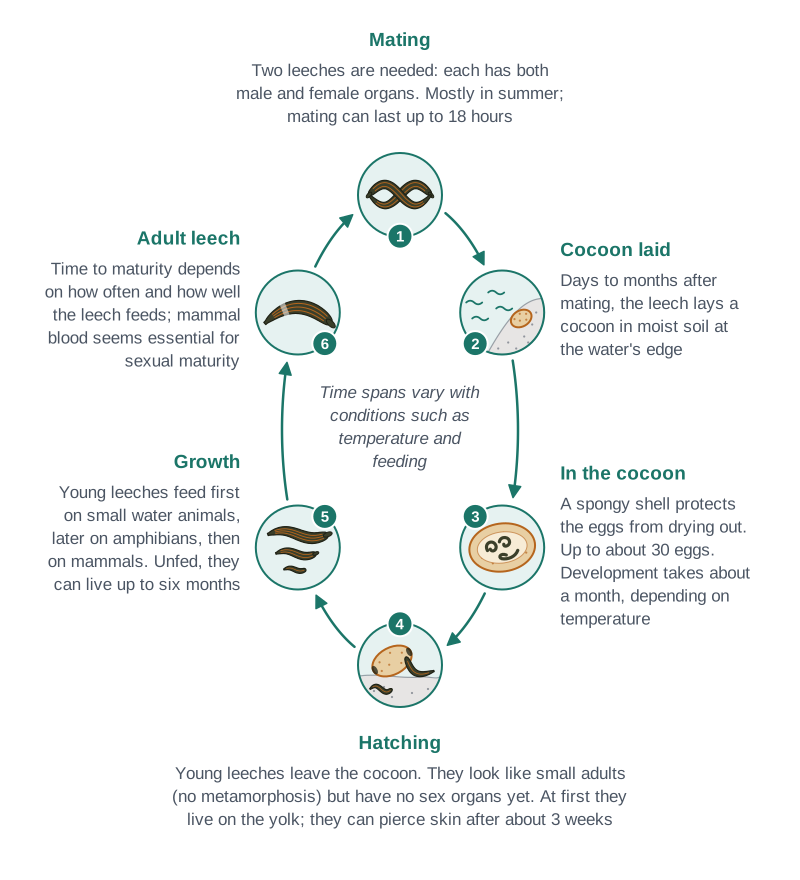
Hermaphroditic Mating
- Sexual system: Simultaneous hermaphrodites — each individual has both male and female reproductive organs
- Cross-fertilization required: Self-fertilization does not occur — two individuals are required for mating
- Mating behavior: Leeches align ventrally, exchange sperm packets (spermatophores), and both individuals become fertilized
- Spermatophore delivery: Hypodermic insemination — sperm injected through body wall
Cocoon Production
- Timing: from several days to three months after copulation
- Deposition site: Moist soil or moss near water — adult leaves water to deposit cocoon
- Cocoon structure: Spongy, foam-like capsule secreted by clitellum (reproductive segment)
- Egg count: 6 to 30 or more eggs per cocoon according to Baskova and Isakhanyan; Michalsen et al. give 10 to 30 young leeches per cocoon
- Incubation: about 4 weeks at room temperature (temperature-dependent: faster in warm conditions)
Hatching
Hatchlings emerge as miniature leeches (7-8 mm) and immediately seek water. They are independent from birth — no parental care.
Developmental Stages
| Stage | Duration | Size (length) | Key Events |
|---|---|---|---|
| Egg | 4-10 weeks | 2-3 mm | Cocoon incubation, embryonic development |
| Hatchling | 0-6 months | 1-2 cm | First feeding, rapid growth |
| Juvenile | 6 months - 1.5 years | 2-5 cm | Multiple blood meals, body segmentation complete |
| Subadult | 1.5-3 years | 5-8 cm | Approaching sexual maturity, clitellum development begins |
| Adult | 2-3 years onward | 8-15 cm | Sexual maturity, breeding, multiple reproductive cycles |
| Senescent | 20-25 years (total) | Variable | Declining reproduction, reduced feeding, eventual death |
Sexual maturity is reached at about 10 months (mean 289 days at 20 °C) in optimal laboratory conditions with regular feeding. In the wild, starvation and environmental variability can delay maturity.
Lifespan and Feeding
Lifespan
- Wild leeches: up to 27 years (longest recorded lifespan)
- Captive/farmed leeches: Variable (controlled feeding may extend lifespan, but breeding turnover prioritizes younger stock)
- Clinical leeches: Lifespan irrelevant — used once and destroyed
Feeding Strategy
- Frequency in nature: Up to about 6 months can pass between blood meals (opportunistic feeding on frogs and mammals)
- Crop storage: Blood stored in lateral caeca (crop) for slow digestion over months
- Starvation tolerance: Can survive 6-12 months without feeding (documented survival up to 18 months)
- Feeding triggers: Warmth, movement, CO₂, skin chemistry
Growth Rate
Growth is episodic — rapid size increase after each blood meal, then plateau during digestion. Hatchlings fed regularly in captivity grow quickly: H. orientalis kept at 28 °C with monthly feeding reached a mean wet weight of about 4.7 g at 6 months and began copulating at 5.5 months. In the wild, irregular feeding slows growth significantly.
Clinical Implications
Single-Use Requirement
Medicinal leeches are regulated as FDA 510(k)-cleared medical devices (FDA 510(k) K040187). Their use is governed by strict safety protocols:
- One patient, one leech, one use: Each leech must be used only once and never reused
- Rationale: Blood-borne pathogen transmission risk (HIV, hepatitis B/C, bacterial contamination)
- Post-treatment disposal: Euthanasia (70% alcohol, after anaesthesia in a weaker alcohol solution) followed by biohazardous waste disposal
- Infection-control guidance: No exceptions — reuse is categorically prohibited
Single-Use Requirement
Supply Chain Considerations
- Breeding programs: Controlled aquaculture facilities supply hospitals with certified leeches
- Quality control: Pathogen screening, species verification, size/weight standardization
- Shelf life: Leeches can be stored unfed for weeks to months before clinical use